Thursday, December 29, 2016

Week of December 18, 2016: Jesus was Born

BIBLE PASSAGE: Luke 2:1-20
MAIN POINT: Jesus was born to be God’s promised Savior.
KEY PASSAGE: Matthew 1:21
BIG PICTURE QUESTION: Why was Jesus born? Jesus was born to rescue us from sin.

Do you think it was just by chance that Caesar Augustus called for a census? Did it just so happen that Mary and Joseph were traveling to Bethlehem—the very place the Messiah was prophesied to be born? (Micah 5:2) God is in control of all things, which He showed by using a pagan emperor to bring about His plan.

After Jesus was born, Mary laid Him in a manger. A king in a manger! It was so unlikely. But Jesus was no ordinary baby. He was God’s Son, sent in the most humble of positions, “not to be served, but to serve, and to give His life—a ransom for many” (Matt. 20:28).

Imagine the shepherds’ surprise when an angel of the Lord suddenly appeared. The Bible says that they were terrified! But the angel said to them, “Don’t be afraid, for look, I proclaim to you good news of great joy that will be for all the people: Today a Savior, who is Messiah the Lord, was born for you in the city of David” (Luke 2:10-11).

What a relief! This angel had come to bring good news. First, he proclaimed a Savior. The people of Israel were well aware of their need for a Savior. They made sacrifices daily to atone for their sin. Finally, a Savior had come who would be the perfect sacrifice for sin, once and for all.

This is the best news ever! An army of angels appeared, praising God and saying: “Glory to God in the highest heaven, and peace on earth to people He favors” (Luke 2:14).

When you share this story with kids, remind them that Jesus came because we needed Him. The purpose of Jesus’ birth was twofold: to bring glory to God and to make peace between God and those who trust in Jesus’ death and resurrection.


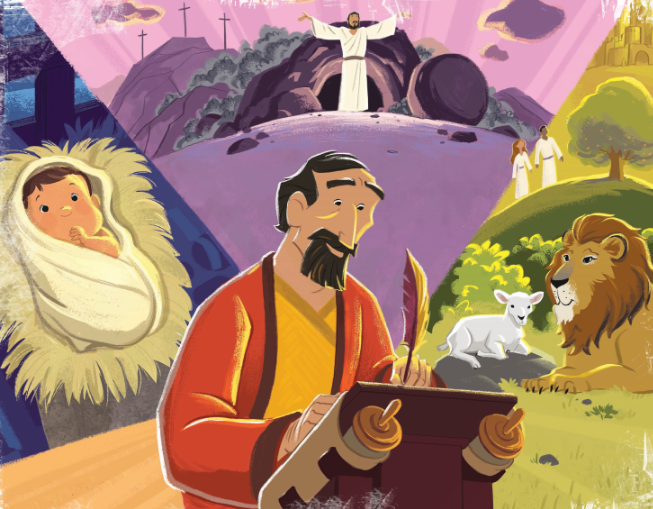
Week of December 11, 2016: Anticipating the Coming King

BIBLE PASSAGE: Isaiah 11:1-10
MAIN POINT: Isaiah prophesied about the coming Messiah.
KEY PASSAGE: Matthew 1:21
BIG PICTURE QUESTION: Why was Jesus born? Jesus was born to rescue us from sin.

Isaiah’s name means “Yahweh is salvation.” God called Isaiah to be a prophet when King Uzziah’s reign was ending—more than 700 years before Jesus was born. At the time Isaiah spoke to the people of Judah, the kingdom of Judah was very wealthy. But the people did not follow God. They worshiped false idols, cheated one another, and mistreated the poor.

Isaiah spoke to the people of Judah at a critical time in their history. After King Uzziah died, the people were afraid. They were vulnerable to their enemies, and their new king was less than ideal. Isaiah’s prophecies warned the people hope. He told of how God would one day rescue those who
were faithful to Him.that God would judge them, but Isaiah also spoke words of hope. He told of how God would one day rescue those who were faithful to Him.

Perhaps the most amazing of all are Isaiah’s detailed prophecies about Jesus—His birth and His suffering and death. Jesus Himself read from the Book of Isaiah, telling the people that He was the One the Scriptures spoke of.

Jesus fulfilled God’s promises spoken by the prophet Isaiah. God kept His promise to send a king from the family of Jesse, the father of King David. (Luke 3:23-32) The Spirit of the Lord rested on Jesus. (Matt. 3:16-17) He was filled with wisdom and understanding. (Luke 2:40) He came to bring salvation to all the nations. (Acts 13:47-48)

Isaiah’s prophecies from God did not speak just to the people of his time; they also speak to us. Hundreds of years before it happened, Isaiah told of how Jesus would be born and how He would suffer and die to take away the sins of His people. We look forward to the day when King Jesus will come back and rule forever. Jesus is the promised Messiah. He will make all of the prophets’ words come true.


Week of December 4, 2016: 16.3 Daniel Was Rescued

BIBLE PASSAGE: Daniel 6
MAIN POINT: Daniel was faithful to God, and God rescued him.
KEY PASSAGE: Daniel 2:20-21
BIG PICTURE QUESTION: How can we obey God? We trust God to give us strength to obey Him.

The fifth chapter of Daniel ends with the death of King Belshazzar when the Persians took over Babylon and Darius was put on the throne. Babylon was on the decline—no longer the powerful, prosperous empire it once was. By this time Daniel was an old man, probably in his early 80s. He served the new king as one of the three leading supervisors in the kingdom.

Daniel was very good at his job. So good, in fact, that King Darius planned to put him in charge of the entire kingdom. The other supervisors and governors were jealous of Daniel. They watched for him to do something wrong so they could complain to the king. Read Daniel 6:4. Daniel was “trustworthy, and no negligence or corruption was found in him.”

Through the malevolent persuasion of the king’s leaders, King Darius passed a law that no one could pray to anyone but him, the king, for 30 days. Daniel continued to pray to God. Even the king’s threat of death did not stop Daniel from praying. The jealous officials turned him in, and Daniel was thrown into the lions’ den.

Daniel was faithful to God—the true King—and God rescued Him. God’s protection of Daniel served to show all the people that the God of Daniel “is the living God, and He endures forever; His kingdom will never be destroyed, and His dominion has no end” (Dan. 6:26).

God also calls us to trust and obey Him no matter what. God sent His Son, Jesus, to rescue us from something much more dangerous than lions. Jesus rescues us from sin and death. Pray that through your faith, and that of the kids you lead, “may the name of God be praised forever and ever” (Dan. 2:20).


Week of November 27, 2016: Shadrach, Meshach, and Abednego

BIBLE PASSAGE: Daniel 3
MAIN POINT: God was with Shadrach, Meshach, and Abednego in the fire.
KEY PASSAGE: Daniel 2:20-21
BIG PICTURE QUESTION: How can we obey God? We trust God to give us strength to obey Him.

Nebuchadnezzar built a tall gold statue and issued a new law: “When you hear music, you are to fall down and worship the statue.” The penalty for defying this law was severe. “Whoever does not fall down and worship will immediately be thrown into a furnace of blazing fire” (Dan. 3:6). So when music played, all the people bowed down and worshiped the gold statue. Well, almost everyone. Shadrach, Meshach, and Abednego refused to bow down and worship the statue. They loved and worshiped the one true God. Only He was worthy of their worship.

The Book of Daniel says that the Chaldeans—a group of astrologers and dream interpreters (see Dan. 2:2,4)—took this opportunity to go to the king and tell on Shadrach, Meshach, and Abednego. But not even the threat of death could convince the three friends to renounce their loyalty to God.

As you teach, lead kids to consider the possibilities: God could keep the friends from being thrown into the furnace. Or, once in the furnace, God could keep them from being harmed. Or if they perished, God would receive them into heaven. The friends’ trust in God enabled them to stand firm no matter what—even as they were tied up and thrown into the fire.

Then something miraculous happened. Nebuchadnezzar saw four men in the fire! They were walking around, unharmed! The Lord not only rescued Shadrach, Meshach, and Abednego, He was with them.

On the cross, people mocked Jesus: “He saved others; He cannot save Himself!” (Mark 15:31). Jesus was not physically unable to save Himself. He chose to do His Father’s will, and His love for sinners kept Him there. Jesus chose not to save Himself so that He could save others.


Week of November 20, 2016: Daniel and His Friends Obeyed God

BIBLE PASSAGE: Daniel 1
MAIN POINT: Daniel obeyed God by not eating the king’s food.
KEY PASSAGE: Daniel 2:20-21
BIG PICTURE QUESTION: How can we obey God? We trust God to give us strength to obey Him.

God’s people had been warned. The prophets had come with messages from God: “Turn from your sin, and turn back to God!” But the people did not listen. The nation of Judah was consumed by idol worship; the kings did what was evil in the sight of the Lord. So God kept His word—He allowed His people to be taken from their land.

Nebuchadnezzar was the king of Babylon, the strong and nation that overtook Judah’s capital of Jerusalem and brought God’s people from Israel to Babylon. Daniel was a young man in Judah when this happened. He might have heard about the prophet Isaiah’s warnings; now he witnessed their fulfillment. (See Isa. 39:5-7.)

King Nebuchadnezzar called for the best young men from Judah to be trained for service in the palace. Among these teens were Daniel and three of his friends. The chosen boys were given new identities—new names, new education, new culture. But Daniel, Hananiah, Mishael, and Azariah stayed faithful to the one true God and refused to make themselves unclean by eating the king’s food.

God blessed Daniel and his friends. Daniel’s obedience to God led to his favor with King Nebuchadnezzar, and Daniel’s life would be a testament to God’s control over all things. God remembered His people during the exile and promised to bring them back to their homeland and set up a new kingdom.

As you share this story with the kids you teach, explain that obedience is not always easy, but we trust God to give us strength to obey Him. Point out that Daniel lived about 600 years before Jesus—the perfectly obedient promised One. We can trust that Jesus will return someday to set up His kingdom forever.


Week of November 13, 2016: Ezekiel Told About a Future Hope

BIBLE PASSAGE: Ezekiel 37
MAIN POINT: God planned to bring His people back to their land and give them new life.
KEY PASSAGE: Ezekiel 11:19-20
BIG PICTURE QUESTION: Why should we obey God? We obey God because He loves us.

Ezekiel had a tough job: ministering to people who had rejected God and suffered the consequences. The exiled people of Judah were eager to blame God for their circumstances. “It’s not fair!” they argued. (See Ezek. 18:25.)

Ezekiel told the people that they were at fault for their exile; their faithlessness had provoked God’s wrath. The people were getting what they deserved. “I take no pleasure in anyone’s death,” God said. “So repent and live!” (Ezek. 18:32).

God gave Ezekiel a vision. In this vision, God showed Ezekiel a valley of dry bones. The bones represented Israel. Ezekiel prophesied that God would put tendons, flesh, and skin on the bones. He would put breath in them so they would come to life.

Ezekiel encouraged the exiles. Apart from God, they were dead. But God was offering them life. He would restore their future. “My dwelling place will be with them,” God said. “I will be their God, and they will be My people” (Ezek. 37:27).

We too are dead in our sin. (Eph. 2:1) Sin separates us from God because He is holy. We are apart from God’s presence. But God does not delight in our death. He is patient and wants us to repent and live!

Hundreds of years after Ezekiel died, God’s presence came to His people through Jesus Christ, Immanuel—meaning, “God with us.” Jesus is the source of life; He offers us living water. (John 4:10,14) If we do not drink of it, we will become like the dry bones. No life will be in us.

Christ changes that. Evangelical Christian apologist Ravi Zacharias wrote, “Jesus did not come into this world to make bad people good. He came into this world to make dead people alive.” Indeed, He does. God saves us by grace, making us alive with Christ through the Holy Spirit. (Eph. 2:4-5)


Week of November 6, 2016: Judah Was Taken into Captivity

BIBLE PASSAGE: 2 Chronicles 36:1-21
MAIN POINT: God sent Judah into captivity because of their sin.
KEY PASSAGE: Ezekiel 11:19-20
BIG PICTURE QUESTION: Why should we obey God? We obey God because He loves us.

Warnings had come from the prophets for decades. God patiently waited for His people to turn from their sin. The prophet Jeremiah spared few details when he warned Judah what would happen if they did not turn from their evil ways. (See Jer. 25:1-14.)

But the people of Judah did not change their ways. The kingdom had been declining for years, despite King Josiah’s efforts to prompt nationwide repentance. When King Josiah died, the people went back to their old ways, worshiping idols and disobeying the Lord.

The time of judgment had come. God used Nebuchadnezzar—the king of Babylon—to deport the people from Judah to Babylon where they would live in exile for 70 years.

Nebuchadnezzar went to Judah when Jehoiakim was king. He put Jehoiakim in chains and took him to Babylon. Jehoiachin became king, and Nebuchadnezzar came back for him too. Many of the people in Judah were taken, along with treasures from the Lord’s temple. Nebuchadnezzar put Zedekiah on the throne in Jerusalem.

The people of Judah were unfaithful to God. Zedekiah  rebelled against Nebuchadnezzar, and God poured out His wrath on Judah. Nebuchadnezzar showed no mercy to the people of Jerusalem. The Babylonians set fire to the Lord’s temple and the king’s palace. They destroyed the wall around Jerusalem. Nebuchadnezzar’s armies carried most of the people away to Babylon as prisoners; only poor farmers were allowed to stay and work the land. The people were held captive in Babylon, serving the king for 70 years.

God did not abandon His people. The prophet Jeremiah told what would happen next: “The days are certainly coming ... when I will restore the fortunes of My people Israel and Judah” (Jer. 30:3). God was going to save His people from captivity and raise up a new King—a foreverKing—from the line of David. (Jer. 30:9)